Political Cartoon Roosevelt s to Blame Again
Introduction
Profound cultural and social conflict marked the years of the 1920s. New cultural attitudes towards race, clearing and evolution, along with changes in the social cloth, pitted the new cosmopolitan culture against more traditional and bourgeois ideals. Social changes included the rise of consumer culture and mass entertainment in the form of radio and movies. The irresolute of sexual mores and gender roles marked a sharp separation from the Victorian by. Prohibition made alcohol illegal, while wild speculation in the stock marketplace, forth with unhealthy corporate structures, ensured the decade'south relative prosperity would end in a Smashing Crash.
Jazz and tabloid journalism charted a new era of sensationalism focusing on sex and crime. While the victorious nations from the Offset World State of war enjoyed the spoils, resentment bred in Germany, setting the stage for future conflict.
In his 1925 novel The Corking Gatsby, F. Scott Fitzgerald wrote: "So we shell on, boats against the current, borne back ceaselessly into the by."
Journalists and media personalities
David Sarnoff
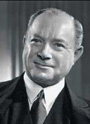
The creator of the National Dissemination Company who helped develop television. Sarnoff became the virtually powerful figure in the communications and media industries. He claimed to have scooped the world on the Titanic disaster, staying at his telegraph primal for 72 hours. In 1915, he submitted a memo to the Marconi Wireless Telegraph Visitor of America, which granted him $2,000 to develop his idea for a "radio music box." By 1924, the box had sold $83 million worth of units. Sarnoff's primary ambition wasn't making money just enlarging the applications of the electronic media through research and evolution.
- National Dissemination Company arrives (video)
- The rivalry between Paley and Sarnoff (video)
William Southward. Paley
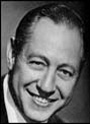
Radio tycoon who headed the Columbia Broadcasting Organization. Paley was regarded as a programming genius who rewrote the nation's definition of amusement and news. In 1928 he bought $50 worth of advertising on Philadelphia station WCAU for his father's visitor, La Palina Cigars. Sales skyrocketed and the family ended upward buying a chain of stations, which Paley renamed the Columbia Broadcasting Arrangement (CBS). He became president of the network on September 28. He gear up his own news organization and recruited a veritable dean's listing of newsmen: Edward R. Murrow, William Shirer and Eric Sevareid, but to proper noun a few.
- Paley takes over CBS (video)
Henry Luce
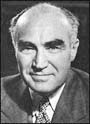
Henry Luce, along with Briton Hadden, launched Fourth dimension magazine in 1923. The magazine developed innovative approaches to news coverage, including packaging the news in topical units and replacing standard newspaper prose with a tricky narrative style. From the showtime, Time was accused of bias; Luce and Hadden were conservatives who opposed authorities interference of business. After Hadden died in 1929, Luce went on to build a media empire that included Fortune, Life, Sports Illustrated and Time-Life books.
William Allen White
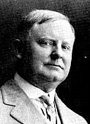
A Kansas editorial writer and newspaper owner who walked among the giants of politics, White worked fervently for the causes he believed in. White even left his newspaper, The Emporia Gazette, to run independently for governor when the two main candidates accustomed endorsements from the Ku Klux Klan. White won a Pulitzer Prize in 1922 for his editorial To an Broken-hearted Friend", defending costless expression.
"You tell me that law is above freedom of utterance. And I reply that you tin can have no wise laws nor free entertainment of wise laws unless there is free expression of the wisdom of the people - and, alas, their folly with information technology. Only if there is liberty, folly will dice of its ain poison, and the wisdom will survive." -- William Allen White, "To an Anxious Friend", July 27, 1922
- William Allen White'due south editorials -- University of Kansas (spider web site)
Freeman Gosden and Charles Corell
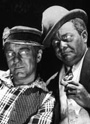
The stars of America's nearly popular radio show, Amos 'northward' Andy. The white men did schtick based on stereotypical blackness men. In an era of blackface amusement, there were no protests. The prove broadcast six nights a calendar week in xv-infinitesimal installments. So popular was the evidence, that America would stop from 7:00 to 7:15, movie theaters would shut off their projectors and roll out radio sets. The show retained its popularity through the 1940s.
- Corell and Gosden get their offset (video)
- Amos 'n' Andy (video)
Will Rogers
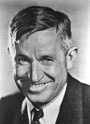
The comedian and social critic rose to radio stardom in 1922. He was famous for saying, "I never met a man I didn't similar." Rogers regarded Congress as his "joke factory." He became a syndicated writer whose columns appeared in more than 400 newspapers. His homespun wit made him a dear national figure. At the 1932 Democratic National Convention, Rogers fell comatose but to wake up to detect he'd been nominated for President. "If elected, I hope to resign," he said. He died in a plane crash in 1935.
- A Will Rogers clip (audio)
Osa and Martin Johnson
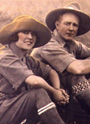
The Johnsons traveled the world photographing and filming their adventures in Africa, the South Pacific and elsewhere. In order to finance their trips, the Johnsons signed contracts to annunciate tobacco, soft drinks, cosmetics and coffee. Their films proved extremely popular and, for a fourth dimension, Osa Johnson's popularity matched that of Eleanor Roosevelt or Ann Lindbergh.
- The Martin and Osa Johnson Safari Museum (web site)
- Osa and Martin film their safaris (video)
- Osa and Martin on the newsreels (video)
- Osa and Martin use corporate advertisement (video)
- Osa expands into motion picture, childrens books, clothes and toys (video)
Bernarr Macfadden

Health guru who earned his fortune from the magazine Concrete Culture. Macfadden introduced the confession magazine in 1919 with Truthful Story, which had a weekly apportionment of more than than 2 million. Its success was attributed largely to its sexual frankness. True Story addressed sexual bug in a clinical rather than erotic mode. Realizing that the word "true" sold copies, Macfadden launched the starting time quasi-factual detective mag, Truthful Detective Mysteries, in 1924. Macfadden's magazines were profitable and innovative, but his newspapers, including the tabloid the New York Evening Graphic, failed.
- Bernarr Macfadden (video)
Walter Winchell
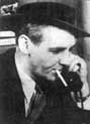
The most widely read columnist in American journalism. His "three-dot" column was a must-read in the New York Evening Graphic and, later, in the New York Daily Mirror. Once he said well-nigh glory: "To become famous, throw a brick at someone who is famous." The content of his columns broadened through fourth dimension, starting with show-biz gossip and expanding to include items about politics and business concern. His writings spawned a journalistic genre. Winchell's greatest media exposure came from his weekly radio broadcasts, which began in 1930 with the greeting: "Good evening, Mr. And Mrs. America and all the ships at sea." After World War II, he was denounced as a fascist by the left for his strong stance against communism.
John R. "Doc" Brinkley
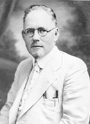
Originally from North Carolina, "Md" Brinkley, a con man with a dubious medical teaching, claimed he could restore male person virility by implanting caprine animal glands from his dispensary in Milford, Kansas. Brinkley and so opened KFKB, one the of starting time radio stations in the land. Unburdened past federal limitations on indicate strength, Brinkley's high-powered station sold his pharmaceuticals and spread his politics nationwide. Afterwards an unsuccessful write-in campaign for the governorship of Kansas, Brinkley would move his functioning to Mexico.
- KFKB, "Kansas Start, Kansas All-time" (video)
- "Turn your radio on"
- Physician Brinkley runs for governor (video)
- Doc Brinkley moves his radio station to Mexico (video)
William Ashely "Billy" Sunday
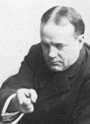
Following a successful baseball career, Baton Sunday traded his uniform for a preacher'south collar, becoming one of the most successful evangelical ministers of the early decades of the 20th century. Preaching conservative christian ethics, Sunday played a crucial office in the Prohibition movement. He would also inspire futurity evangelical ministers with his charismatic — and athletic — preaching fashion, as well as his utilize of radio to spread his message.
- Sunday morning radio (video)
Political scene
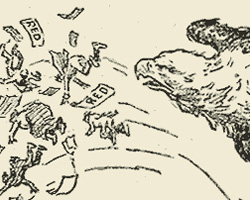
Detail from a cartoon entitled "Cleaning the Nest"
With the end of Earth War I came deep-seated fears of political radicalism, the beginnings of what would become the "Blood-red Scare." Earlier the end of the Wilson presidency, Attorney General A. Mitchell Palmer led raids on leftist organizations such as the International Workers of the Earth, a labor union. Palmer hoped his crusade against radicalism would usher him into the presidency. He created the precursor to the Federal Bureau of Investigation, which collected the names of thousands of suspected Communists.
More than 500 aliens on the list were deported, including the radical orator Emma Goldman. Palmer claimed he was ridding the country of "moral perverts," only his tactics, which tended to violate ceremonious liberties, proved to be too callous in the minds of the electorate.
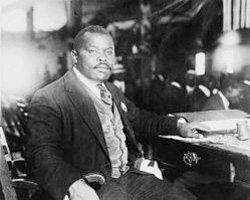
Marcus Garvey
During the early 1920s, the ranks of the Ku Klux Klan swelled to 4.5 million. The Klan helped to elect 16 U.S. Senators, equally well equally many Representatives and local officials. When David Curtis Stephenson, Indiana's head Klansman, was bedevilled of kidnapping and sexual assault in 1925, indictments and prosecutions of Klan-supported politicians on corruption charges followed. Nationwide membership of the Klan brutal to just 45,000 in 5 years.
Marcus Garvey, the "Black Moses," led a national move whose theme was the impossibility of equal rights in white America. Garvey preached blackness pride, segregation and a render to Africa, but the decade's currents of white supremacy overpowered him. He was charged with mail fraud, jailed and deported.
William Allen White, a modest-town editor in Emporia, Kansas, crusaded against the Klan and for free speech. In his Pulitzer Prize-winning editorial, he wrote: "If there is freedom, folly volition die of its own toxicant."
- William Allen White (pdf)
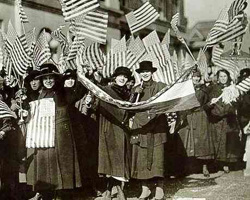
Woman celebrating the passage of the 19th Amendment.
With the passage of the 19th Amendment, women were given the right to vote in 1920, but voting remained an upper- and middle-class activity. No new opportunities in the workplace arose, and the momentum of the women's movement at the beginning of the decade was eventually swallowed by the ascent of consumer culture.
Warren G. Harding, a Republican Senator from Ohio, was elected President in 1920. Under Harding, regime's previous efforts to regulate business practices were relaxed in favor of a new emphasis on corporate partnerships. Best known for a series of outrageously corrupt political scandals, Harding'southward presidency was non without its merits. He pardoned Eugene Debs, the imprisoned Socialist Party leader; he persuaded the steel industry to enact an 8-hour workday; and he helped slow down the arms race. However, his administration was stacked with decadent officials who gave kickbacks to the Justice Section and the Veterans Agency. After Harding died of a stroke while still in office in 1923, the Teapot Dome scandal bankrupt, revealed that individual oil companies had been draining oil from federal lands.
- The presidency of Warren One thousand. Harding (video)
- Corruption in the Harding administration (video)
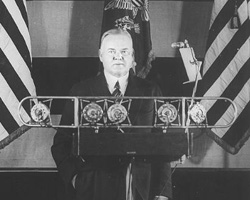
Herbert Hoover
Harding's sudden demise meant his Vice President, Calvin Coolidge, held the top office. Nicknamed "Silent Cal," Coolidge was asked during the 1924 election if he had anything to say about the world state of affairs. His answer: "No." All the same, a divisive Democratic Political party helped the incumbent win the ballot by 7 1000000 votes.
- Calvin Coolidge, a.thou.a. "Silent Cal" (video)
When the Democrats nominated Al Smith, an Irish-Cosmic from New York's Lower East Side, for President in 1928, the party airtight ranks behind him, simply economic prosperity and anti-Cosmic sentiment kept Smith from being elected. He is credited with awakening a vast army of immigrants in the big cities and with shifting African-American voters toward the Democrats.
The 1928 President-elect, Herbert Hoover, envisioned a private economy that would operate generally free from regime intervention. Predicting ever-greater prosperity, he said, "We shall shortly, with the help of God, be in sight of the day when poverty volition exist banished from this nation." Merely then the stock market fell out from nether him.
- Hoover elected (video)
Social climate
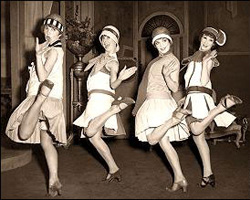
"Flappers"
The epitome of the 1920s every bit a decade of prosperity, of flappers and hot jazz, is largely a myth, even in the eyes of the author who coined some of those terms. In his article "Echoes of the Jazz Age," F. Scott Fitzgerald wrote: "Information technology was borrowed fourth dimension anyway – the whole upper tenth of a nation living with the insouciance of a m duc and the casualness of chorus girls."
At that place is some truth to the decade's image of prosperity but, as Fitzgerald notes, it was concentrated at the top. Half-dozen meg families fabricated less than $1,000 a yr. Co-ordinate to the Brookings Institution, 1-tenth of 1 pct of families at the acme took in equally much income as 42 pct of families at the bottom. In New York City, millions of people lived in tenements condemned as firetraps. When Fiorello La Guardia, a Congressman from E Harlem, toured the poorer districts of New York in 1928, he reported: "I confess I was not prepared for what I really saw. It seemed almost incredible that such weather of poverty could really exist."
- F. Scott Fitzgerald Additional Papers (web site)
- Flappers (video)
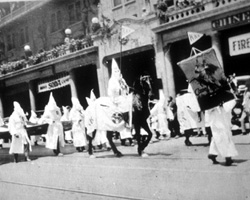
The Ku Klux Klan march in Stocktan, California, during the 1920s.
Labor strikes broke out, pitting coal miners and railroad men against their powerful employers. Burton Wheeler, a Senator from Montana, visited one of the strike areas: "All day long I have listened to heartrending stories of women evicted from their homes by the coal companies. I heard pitiful pleas of piffling children crying for bread. I stood aghast as I heard most amazing stories from men brutally beaten by private policemen."
At that place was a sweeping crackdown on immigration. New quotas were established that heavily favored Anglo-Saxons. China, Bulgaria, Palestine and the African nations could transport no more than than 100 people. England and Northern Republic of ireland could send 34,000, while Italy could ship just under four,000.
Fitzgerald and Sinclair Lewis were office of a generation of writers, artists and musicians who were amid the most innovative in the country's history. Traditional taboos concerning sexual activity and gender politics were challenged. The country went dry on January 16, 1920, subsequently Prohibition was successfully linked with Progressive Era causes, such as reforms to cease married woman chirapsia and child abuse.
- Prohibition rises (video)
- Prohibition fosters organized crime (video)
- Sinclair Lewis (PDF)
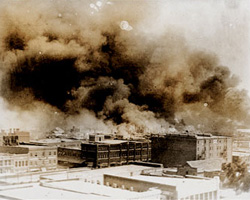
The African-American district burns during the Tulsa race riots of May, 1921.
The 1920s also saw a rising in tension betwixt whites and blacks. In May of 1921, a large department of Tulsa was burned to the basis and a number of blacks and whites were killed. Some of the worst racial violence in American history took identify during the 1920s. On the get-go day of 1923, a white mob searching for an alleged rapist burned all but one building in the tiny blackness settlement of Rosewood, Florida. Millions of blacks moved to northern cities. Soon, the black population of Chicago had swelled by 148 percent, Detroit's past 611 percent. Many cities adopted residential segregation ordinances to continue blacks out of white neighborhoods.
The United states of america became a consumer society in the 1920s. The automobile was its symbol; past 1929, there were 27 meg autos on America'south roads. Cigarettes, cosmetics and synthetic fabrics became staples of life. The rise of radio and the talking move pictures (ninety million Americans were going to them weekly) helped create a new popular culture that disseminated mutual speech, apparel and beliefs.
- The Ku Klux Klan rises (video)
- Timeline of the Tulsa Race Anarchism (spider web site)
Media moments
1920 — KDKA, the outset official radio station
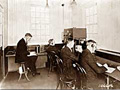
Frank Conrad of Pittsburgh, Pennsylvania, first started experimenting with the recently invented medium of radio in 1912. At the fourth dimension, the technology primarily functioned as a ways of naval communications; a lesson learned from the sinking of the Titanic. Every bit the public began purchased amateur radios, Conrad's broadcasts became popular. Conrad is credited with inventing radio ad when he started mentioning the name of the store giving him new records to play on the air. Westinghouse Electric Visitor, Conrad'south employer, recognized the potential of his hobby and began manufacturing and selling more radio receivers. On October 27, 1920, Westinghouse received the first formal license from the federal government to circulate as a terrestrial radio station. Designate KDKA, the station gained instant success when information technology circulate live results of the 1928 presidential election.The call letters, KDKA, behave no significance, and would take been awarded to a naval station had Westinghouse and Conrad not discovered a new use for the engineering science.
- KDKA comes alive (video)
1924 — Leopold and Loeb
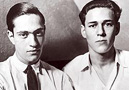
Another "trial of the century." The two teenagers from highly privileged Chicago families, Nathan Leopold and Richard Loeb, kidnapped, killed and mutilated a 14-yr-old neighbor. The case challenged previously held notions of juvenile killers with below-average IQs. Leopold would describe the pair as evil geniuses who were higher up normal standards of morality. Their attorney, Clarence Darrow, introduced the psychiatric defence force into the legal system. The jury and the press accepted Darrow's argument that social club, schools and fierce social conditions were to blame, and the killers avoided execution.
- Illinois v. Nathan Leopold and Richard Loeb -- Famous American Trials (web site)
1925 — Scopes Monkey Trial
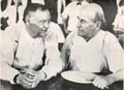
Fundamentalist-christians introduced 37 anti-development bills to 20 state legislatures during the 1920s, and the first one to pass was in Tennessee. Taking upwards the ACLU's offer to defend anyone who violated the new police force, Dayton, Tennessee, booster George Rappleyea realized the town would go all kinds of publicity if a local teacher was arrested for teaching development. He enlisted John Scopes, a science instructor and football coach. The trial was marked by a carnival-like temper; for 12 days, 100 reporters sent dispatches from Dayton. Scopes' $100 fine was later thrown out on a technicality. It went downward in history and literature every bit one of America's best-known trials and symbolized the conflict between religion and reason.
- Tennessee vs. John Scopes, the "Monkey Trial" -- Famous Trials in American History (web site)
- Scopes Monkey Trial (video)
May 21, 1927 — Lindbergh'due south flight
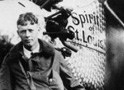
25-twelvemonth-onetime Charles Lindbergh completed the first solo nonstop transatlantic flight in history in "The Spirit of St. Louis." The trip was 3,610 miles, outset from Roosevelt Field on Long Isle and ending in Paris afterward 33 hours and thirty minutes. The aftermath was what came to be known every bit the "Lindbergh smash" in aviation: manufacture stocks rose and interest in flying skyrocketed. Lindbergh's subsequent U.S. bout demonstrated the potential of the plane as a prophylactic and reliable fashion of transportation.
- Lindbergh history -- The Charles A. and Anne Morrow Lindbergh Foundation (spider web site)
- Test flying (video)
- Lindbergh'due south celebrated takeoff (video)
- Parades greet Lindbergh (silent video)
1928 — Ruth Snyder Executed
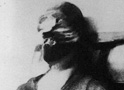
Ruth Snyder, a discontented Long Island housewife, convinced her lover, Judd Grayness, that her married man was mistreating her. The pair killed him with a sash weight. Their trial was a media frenzy, attended past such celebrities as picture show pioneer D.Due west. Griffith and evangelist Billy Sun. The jury was out 98 minutes earlier it returned with a guilty verdict. Gray was executed first on Jan 12, 1928. Snyder followed just a few minutes later. A clever photographer from the New York Daily News, with a photographic camera strapped to his ankle, snapped a picture of her equally the juice coursed through her trunk. It sold 250,000 actress copies and is the iconic image of the 1920s.
- The Ruth Snyder execution photo on the forepart page of the New York Daily News (paradigm)
- Thomas Howard's ankle camera -- Smithsonian National Museum of American History (spider web site)
October 29, 1929 — The Stock Market crashes
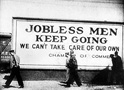
Heavy speculation on in stocks cause a bubble which burst in October. Fortunes were lost almost instantly. Breadlines filled with the unemployed and the homeless become commonplace. This unprecedented downturn in the economy would cause stagnation and strife around the world. The Roaring Twenties come to screeching halt and the Peachy Depression settled in, dominating the 1930s.
- The crash, October 29, 1929
Trends in journalism
The silent newsreels first produced by Pathe Weekly in 1911 became hugely pop talkies when Theodore Instance developed his sound-on-film system.
The shift from print-based journalism to electronic media began in the 1920s. Competition between newspapers and radio was minimal, because the latter was not however an effective news medium. People listened to radio bulletins, merely to "read all about it" they picked up a tabloid or a broadsheet.
The New York Earth was by and large known equally the best paper of the decade. Regarded as "the newspaperman's newspaper," it was, in stature, the New York Times of its twenty-four hour period, relying on solid reporting and writing instead of broad coverage. The paper's lauded and independently liberal editorial folio was edited past Walter Lippmann, who became one of the most influential American writers of the century. The newspaper's merger into the World-Telegram is seen as a black day in newspaper history.
The talkie newsreel was born when Theodore Case developed his sound-on-film organization. The Fox Film Corporation bought Example'due south arrangement in 1926 and developed Fox Movietone News. The beginning talkie newsreel showed Charles Lindbergh taking off on his transatlantic flight on May 20, 1927. Its enormous success compelled other studios to produce competing newsreels. They became and so pop that theaters showing only newsreels opened in major cities around the country.
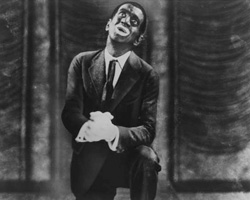
Al Jolson, a white man, performing in "blackface".
Radios were offset marketed for home apply in 1920. By 1929, they sold five million sets every twelvemonth. RCA'southward Radiola was the nearly widely advertised model, selling for $35. RCA formed the National Broadcasting Visitor, which had its first broadcast on November fifteen, 1926. Programming remained unimaginative until the end of the decade, relying on speeches, lectures (on such topics equally basket weaving) and music. In 1925, more than seventy percentage of air time was devoted to music; less than 1 percent was devoted to news. By 1929, 40 pct of the population owned radios, tuning in to hear music, sports scores, Al Jolson (the decade'south summit star) and Amos 'north' Andy.
Jazz journalism brought with it sensational stories printed in a popular tabloid format. Modern media's obsession with sex and criminal offense has aught on the era's scandalous content. Stories such equally the 1922 Hall-Mills instance (involving the murder of a minister and a choir singer) and the 1927 Snyder-Grayness case (involving the murder of a husband past an cheating married woman) gripped the nation. Competing tabloids included Joseph Medill Patterson's The New York Daily News, William Randolph Hearst'due south The New York Daily Mirror, and Bernarr Macfadden'due south New York Evening Graphic, too known equally the "Porno-Graphic."
Mod advertising took root in the 1920s when advertising agencies started to take shape.
- The nascence of modern advertizing (video)
Source: https://history-journalism.ku.edu/1920/1920.shtml
0 Response to "Political Cartoon Roosevelt s to Blame Again"
Postar um comentário