How Does General Custer by Andywarhol Make Fun of 20th Century Art
"I was disappointed that nobody in Dallas wears cowboy hats anymore. The cowboy expect is expressionless, I guess." —Andy Warhol (Warhol Diaries, Nov xx, 1985 excerpt)
Andy Warhol's final major portfolio Cowboys and Indians is truly a tour de force. Showcasing the artist's fascination with pop culture, his appreciation of Ethnic art, and his virtually prophetic, insight into the depths of the American imaginary, Warhol's Cowboys and Indians remains an boggling serial in the later part of Warhol's career. With vivid color and thought-provoking juxtaposed images of U.S. Americana and Indigenous peoples' civilization, Warhol offers a new view of the frontier—one of centering performances, public opinion, and hard historical exchanges. Looking beyond the prints to Warhol'due south source imagery reveals an immense level of depth and consideration from the artist. Upon publication of the edition in 1986, a complete prepare of Cowboys and Indians was donated to the Smithsonian National Museum of the American Indian.
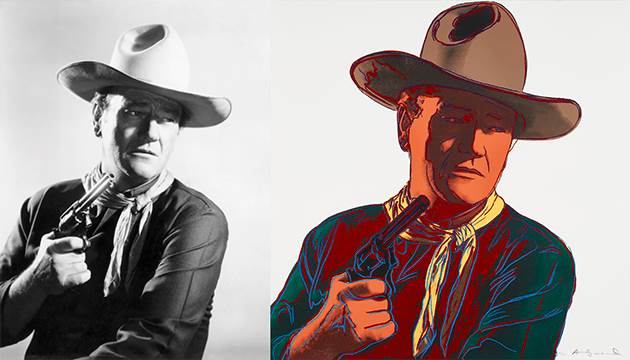
A publicity photo for John Ford'due south 1962 The Human being Who Shot Freedom Valance served as the reference prototype for Warhol's portrait of John Wayne. As a western motion-picture show enthusiast, Warhol was taken with the Wayne and Ford westerns. He directed the 1968 film Lonesome Cowboys, a tongue-in-cheek ode to the western genre inspired past Wayne/Ford collaborations like Stagecoach, The Searchers, and The Human being Who Shot Liberty Vallance. Warhol donned a cowboy hat and boots on set up while filming. Warhol'south John Wayne is the nearly contemporary field of study depicted in the series. Only rendered alongside historical figures like General Custer, Teddy Roosevelt, and Geronimo appears to comment on the intermingling of fantasy and reality in our understanding of the western frontier. John Wayne appears as real as information technology gets. Unlike the Plains Indian Shield, however, his revolver isn't a weapon for survival—it'southward a prop.
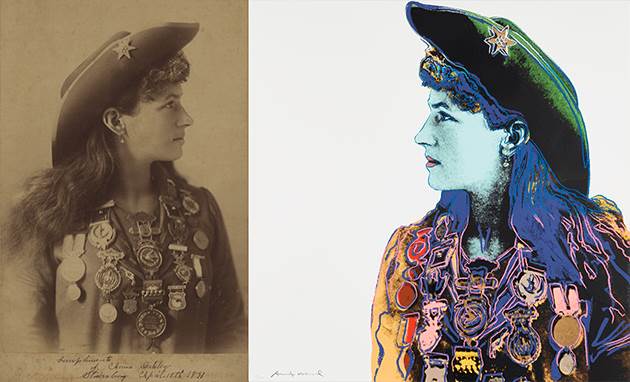
Annie Oakley, pictured (left) by British photographer Anthony Percival in 1891, appears here busy with her numerous sharpshooting medals. Renowned for her immense accurateness, Oakley was a star performer in Buffalo Bill's Wild West traveling show from 1886 to 1902. Rising to prominence at historic period fifteen, after defeating famed sharpshooter Frank Due east. Butler in a shooting competition, she earned the monikers "The Little Sure Shot of the Wild Westward" and "The Peerless Lady of Wing Shot." Warhol's vibrant Annie Oakley revivifies Oakley's nineteenth century fame, emphasizing her position not as the dryad in distress architype typically seen in Westerns, but as an active amanuensis. Warhol's portrait of Oakley further complicates the murky distinction between the imagined westward and the realities of life on the American borderland. She was an entertainer like John Wayne simply fired a rifle like Full general Custer. Her medals are earned in competition but serve the purpose of costume. Warhol effectively leverages this hit image to deepen his exploration of performance and its relation to U.S. westward expansion.
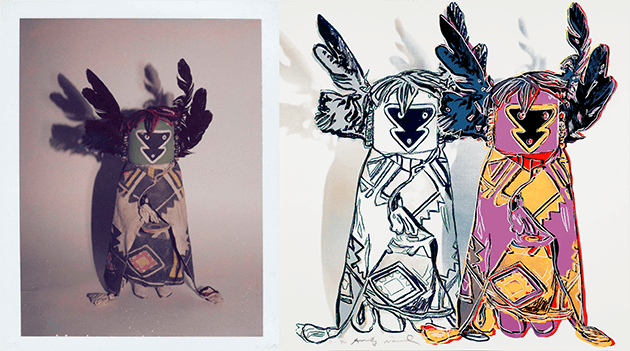
Produced by a Hopi Pueblo carver at an unknown date, Tumas kachina is one of three Ethnic peoples' works referenced in Warhol's Cowboys and Indians. Referencing a Polaroid taken at the Smithsonian National Museum of the American Indian in 1985, Warhol'southward Kachina Dolls depicts Tumas (also known as Angwusnasomtaka and Crow Mother), a dame spirit in Hopi mythology. Kachina Dolls stands out within the Cowboys and Indians series as Warhol takes a more involved arroyo to interpreting his source textile. Not only has he taken the reference Polaroid (as is also the case for Plains Indian Sheild and Northwest Coast Mask), but Warhol's touch is perhaps well-nigh felt here as he chooses to duplicate the referenced kachina doll.
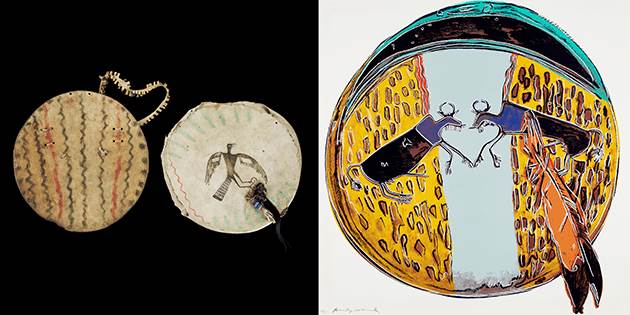
Plains Indians Sheild depicts a Crow Tribe (Apsáalooke) shield the artist photographed at the Smithsonian National Museum of the American Indian in 1985. A similar Crow shield (left), now displayed at the Penn Museum, has been reproduced in a higher place in place of an image of the original, in accordance with the wishes of the Crow Tribe. Warhol's Plains Indian Shield depicts a simultaneously tactical and decorated object, like the military uniforms in Warhol's portraits of General Custer and Teddy Roosevelt. The shield, as a defensive object of war, serves as formal and cultural contrast to the epitome of an armed John Wayne or the stern General Custer. Interestingly, Crow warriors served alongside Custer's companies during the Cracking Sioux War of 1867, fighting alongside U.S. Forces at Little Bighorn. The shield also echoes the Indian Caput Nickel—another object of value and utility adding a visually circular tableaux to the portfolio.
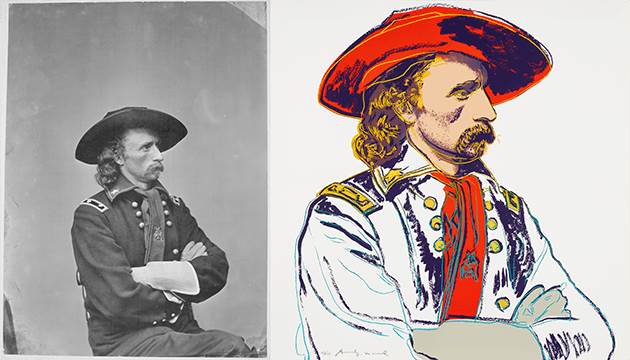
George Armstrong Custer's famous last stand up at Footling Bighorn is possibly the nearly recognizable episode of the American Indian Wars spanning from the early 17th Century through the final battles of the Apache Wars in 1924. Equally a major general during the Ceremonious State of war and later a lieutenant colonel in the Indian Wars, Custer became a household proper noun in no small-scale office due to his distinctive dress, prolific writing, and willingness to invite journalists to observe his companies. Custer scholar Michael C. C. Adams remarks, "Custer was a largely self-created media personality who worked hard to stay in the popular mind." Custer's death in The Great Sioux State of war of 1876 was reported widely, inspiring poems, prints, and books valorizing Custer's final moment and elevating him to mythic status. Despite contrasting reports from eyewitnesses, a unified and dramatic tale of Custer's Last Stand persists in the American imagination. Warhol's General Custer, emphasizing the effigy'southward distinctive red necktie and longer-than-regulation golden locks, presents Custer the "self-created media personality." With undeniable wit, Warhol surrenders much of the pallet of this print solitary to its subject, letting the general's penchant for pageantry speak for itself.

Warhol'southward vibrant Northwest Declension Mask is the final piece of work in Cowboys and Indians to draw from Indigenous work the artist encountered in the Smithsonian National Museum of the American Indian. The piece is a Kwakwaka'wakw (Kwakiutl) ceremonial mask depicting two-headed sea serpent Sisiutl. Anthropologist Audrey Hawthorne writes that Sisiutl, "the most oftentimes depicted supernatural character [in Kwakiutl art], was cardinal to the themes of warrior power, force and invulnerability; the ability to cause death; and the contrasting theme of revival." The mask is a circuitous spectacle unto itself, displaying bright colors, intricate patterning, and moving fins operable past its wearer in performance. Again tackling the intersection of state of war and performance, Warhol presents an object of ceremony dealing with strength and mortality.
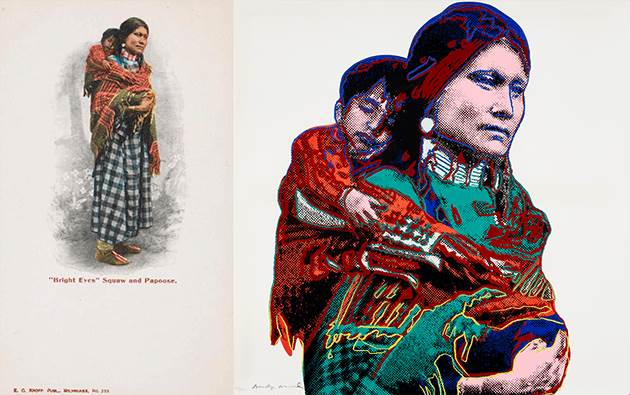
Mother and Child takes as its reference image a item from a postcard published by Milwaukee's E.C. Kropp Visitor. The mid-late nineteenth century brought with it both advancements in mechanized collotype press and an expanding market for pictorial ephemera. Alongside images of recognizable landmarks, Native American imagery was a popular genre of these small prints. With little mind to agreement, respect, or rigor, exoticizing postcards employed reductive stereotypes and racial epithets, depicting its subjects as the 'noble savage.' Warhol's Mother and Kid opts for a more respectful, less exotic championship and a much tighter crop. The figures' faces are emphasized, individualizing the mother and child depicted. Female parent and Kid, seems too to reference the religious imagery of the Madonna and Child—bringing a greater sense of reverence and art historical depth to his subjects as opposed to the original postcard delineation.
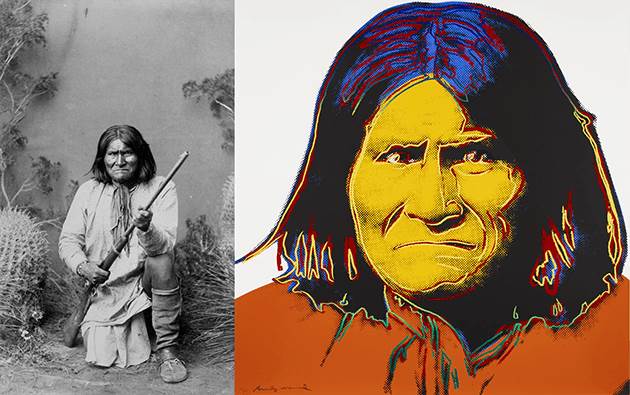
Geronimo (Goyaałé), like General Custer, is an immense effigy in the mythos of the American Indian Wars. He kickoff rose to public notoriety as a leader of Apache Chihuahua raids in the southwest. Warhol's portrait is based on a photo taken by A.F. Randall. In the original portrait, Geronimo is pictured with a burglarize, surrounded by bits of southwestern castor. Withal in truth, Randall'due south photo depicts Geronimo the prisoner, before long after his 1886 surrender. In the remaining years of his life, he would remain a prisoner of war, habitually making appearances equally a public attraction: the 1904 Globe's Off-white, Teddy Roosevelt's 1905 inaugural parade, and in wild west shows. Warhol's Geronimo (as with Mother and Child) finally grants his subject the courtesy of a neutral background free of faux ready pieces—a courtesy afforded to Wayne, Oakley, Custer, and Roosevelt by their respective original portraitists. In that location is a greater nobility afforded to Geronimo in Warhol'southward print, plucking his field of study from the condescending, staged setting of the original photograph as a pw.
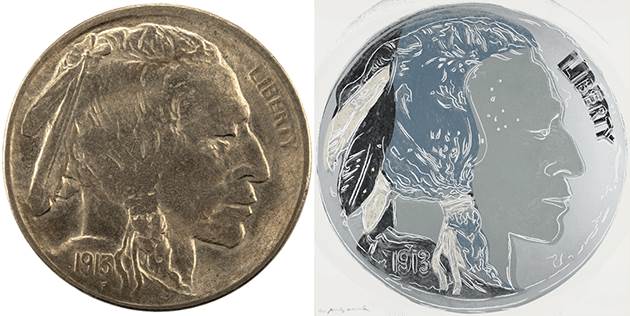
Indian Head Nickel depicts the obverse of the Indian Head/Buffalo nickel designed past American Sculptor James Earle Fraser. Born in the Dakota Territory 1876 (the year of Custer's death), Fraser depicted Indigenous people in his sculptures throughout his career. The Indian Head/Buffalo nickel, beginning minted in 1913, was Fraser's replacement for Charles Barber'south 1883 Freedom Head nickel. Fraser's goal was simple: to brand sure his design "could not be mistaken for any other country'southward coin," to create "something totally American." Warhol's Indian Head Nickel references the artist's earlier work depicting dollar bills and dollar signs, standing Warhol's exploration of the connectedness between commerce and image product. Simply, by emphasizing the coin's text 'LIBERTY' and presenting it alongside the portraits other cultural products depicted in Cowboys and Indians, Warhol offers an incisive reflection of the American imagination—his ii-cents was more than just pocket change.
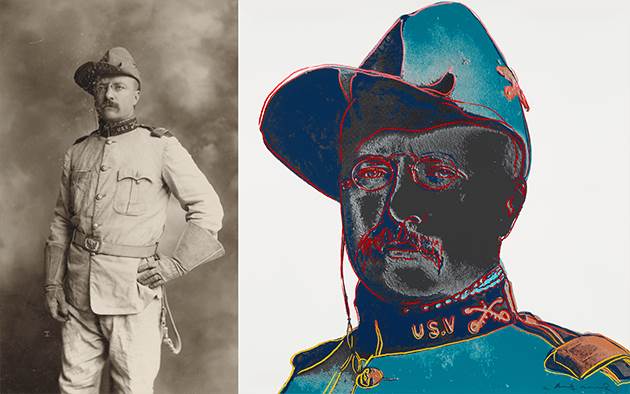
The last work in Warhol's Cowboys and Indians draws from an 1898 portrait of then Colonel Theodore Roosevelt during the Spanish American State of war. After making headlines leading the 'Rough Riders' in Republic of cuba, upon his return, Roosevelt was elected Governor of New York. In 1900, he was elected vice president on a ticket with incumbent William McKinley. And mere months afterward, post-obit McKinley'south assassination, Roosevelt was sworn in as president of the Usa. Over the form of his breakneck rise to power, Roosevelt leveraged his public persona as a state of war hero, frontiersman, and naturalist to great political expedience. Warhol'due south Teddy Roosevelt captures the figure only before his rapid political ascension, playing off the office that first garnered him national attention. Depicting Roosevelt's face up in inverted tones, Warhol calls attending to the thought, similar the moving picture negative, that this prototype is fundamental—that the colonel underlies the president. Often overlooked in discussions of Warhols presidential portraits, Warhol's Teddy Roosevelt offers not only some other stylized portrait, but a serious wait at the weather condition and myth of producing presidents. Teddy Roosevelt'south inclusion in Cowboys and Indians suggests the concrete, political results of America's fascination with the west—a fascination that took him all the fashion to the White Business firm
-
Broschofsky Galleries, Ketchum, Idaho
Private Collection, acquired from the above past the present owner -
Frayda Feldmann and Jörg Schellmann 377-386
-
Including: John Wayne; Annie Oakley; General Custer; Northwest Coast Mask; Kachina Dolls; Plains Indian Shield; Mother and Kid; Geronimo; Indian Head Nickel; and Teddy Roosevelt
-
American • 1928 - 1987
Known equally the "King of Pop," Andy Warhol was the leading face of the Pop Fine art movement in the United States in the 1960s. Following an early career as a commercial illustrator, Warhol achieved fame with his revolutionary series of silkscreened prints and paintings of familiar objects like Campbell's soup tins, and celebrities like Marilyn Monroe. Obsessed with pop culture, celebrity, and ad, Warhol created his slick, seemingly mass-produced images of everyday subject matter from his famed Factory studio in New York Metropolis. His utilise of mechanical methods of reproduction, notably the commercial technique of silk screening, wholly revolutionized fine art-making.
Working equally an artist, just also director and producer, Warhol produced a number of avant-garde films in add-on to managing the experimental rock ring The Velvet Underground and founding Interview mag. A key figure in the New York art scene until his untimely expiry in 1987, Warhol was notably a mentor to such artists as Keith Haring and Jean-Michel Basquiat.
Source: https://www.phillips.com/detail/andy-warhol/NY030221/75
0 Response to "How Does General Custer by Andywarhol Make Fun of 20th Century Art"
Postar um comentário